
Via Mobility Services
Case Study: Solar Carport Microgrid Powers Resilient,
Sustainable Transit for Riders with Limited Mobility






CHALLENGE
Via Mobility Services provides essential transportation for people with limited mobility across the Boulder, Colorado region. Their mission demands absolute reliability — when a bus doesn't run, real people miss medical appointments, work, and independence. At the same time, rising energy costs were placing growing pressure on Via's operating budget, diverting resources away from service delivery.
Colorado's volatile weather compounded the challenge. Via's fleet of short and long buses — an expensive, mission-critical asset — sat exposed to increasingly frequent and destructive hailstorms. A single severe storm event could inflict significant damage across the entire fleet, threatening both the vehicles and the continuity of service.
Grid reliability added yet another layer of risk. Power outages, whether from severe weather, grid strain, or utility incidents, threatened Via's facility operations and EV charging infrastructure at exactly the moments when resilient transit is needed most.
SOLUTION
A Holistic, Grid-Interactive Microgrid Designed from the Ground Up
A multi-faceted solution
-
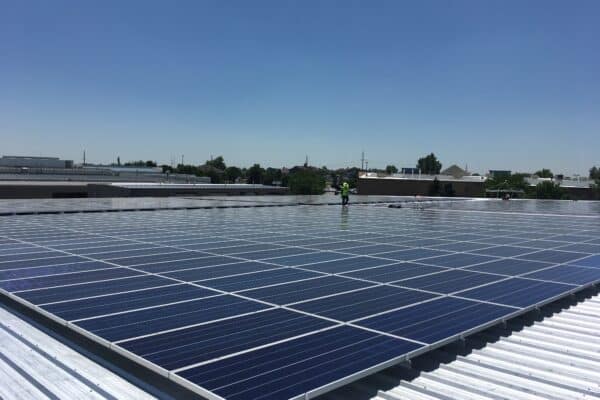
300kW Solar Carport Capacity
-
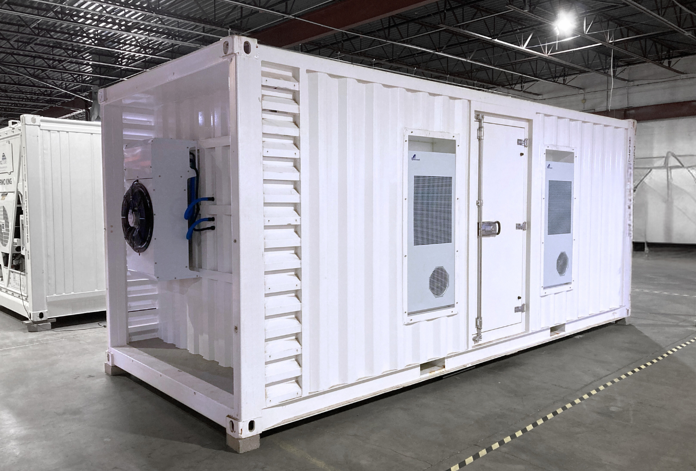
1.1MWh Battery Energy Storage
-
500kW Peak Battery Power
-
100% Operational Uptime Target
IPOWER Alliance partnered with Via Mobility Services and an exceptional team of Boulder-area engineering and technology specialists to design and deliver a comprehensive, integrated microgrid — one of the most complete resilient energy systems deployed for a public transit operator in Colorado.
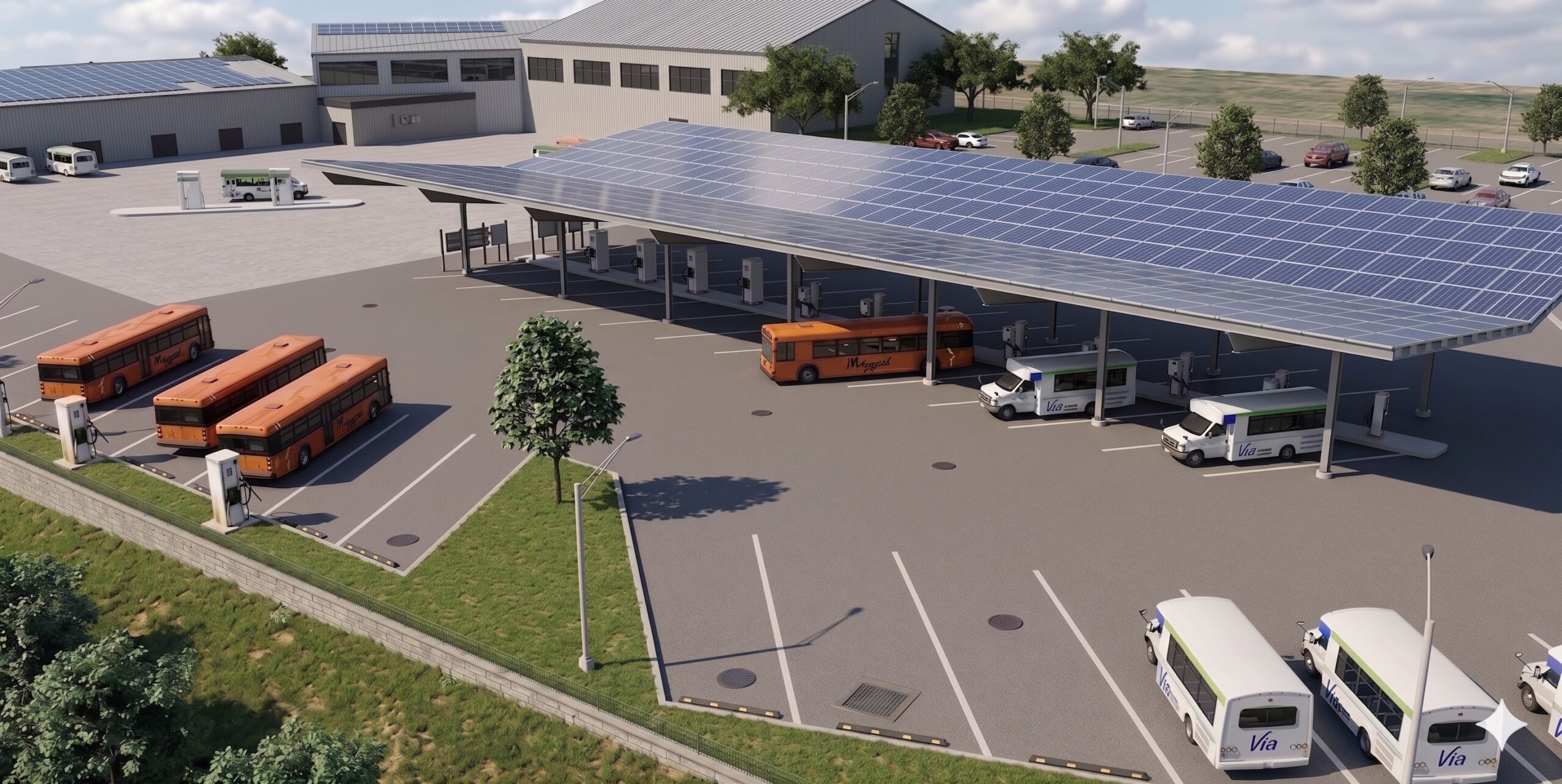
The centerpiece is a custom-engineered 300 kW solar carport, purpose-built not only to generate clean electricity but to physically protect Via's entire bus fleet from hail, UV degradation, snow, and weather-related wear. The structural design accommodates Via's mix of short and long buses, providing meaningful fleet asset protection alongside renewable generation.
Paired with a 1.1 MWh / 500 kW battery energy storage system (BESS) designed and supplied by Kronus Engineering, the microgrid operates with intelligent autonomy. During normal grid conditions, stored solar energy is deployed during peak-rate periods to minimize demand charges and reduce energy costs. When the grid fails, the system automatically islands and continues powering the facility, EV chargers, and critical operations — backed by a small generator for extended outage scenarios when solar generation is unavailable.
Microgrid Labs provides the intelligent energy management layer — monitoring all energy flows in real time and orchestrating the interplay between solar generation, battery storage, EV charging loads, and facility consumption to maximize both resilience and economic performance.
Multiple Advantages, One Integrated System
Because every component was designed to work together from the outset, the Via Mobility microgrid delivers benefits that would be impossible to achieve through piecemeal solutions. Solar generation, battery storage, weather protection, EV charging, and intelligent control reinforce one another — creating a sum substantially greater than its parts.
This holistic approach is the hallmark of IPOWER Alliance's methodology: assessing each client's complete operational picture before specifying any technology, then engineering an integrated system that addresses multiple challenges simultaneously.
-
Environmental Impact - Clean, renewable solar energy directly powers electric transit operations — reducing carbon emissions at every mile driven.
-
Fleet Protection - Custom-engineered carport shields the entire bus fleet from Colorado's hail, UV, snow, and weather damage.
-
Energy Resilience - Battery storage ensures 100% operational uptime during grid outages — critical for a transit provider serving vulnerable riders.
-
Cost Savings - Intelligent load management, demand charge reduction, and solar generation significantly reduce Via's electricity expenses.
-
Local Economic Development - Project leverages an all-Boulder-area team of engineering and technology innovators.
Boulder County Cooperation: A Team of Local Experts, Working as One
One of the most distinctive aspects of this project is the depth and quality of the Boulder-area team assembled by IPOWER Alliance. Each partner brings specialized expertise, and their collaboration — coordinated by IPOWER as lead EPC — is what makes the integrated design possible.
Financing & Incentives: Making the Economics Work
The Via Mobility microgrid demonstrates that advanced resilient energy infrastructure is financially achievable for mission-driven organizations. The project was made possible through a combination of grant funding, federal tax incentives, and innovative construction financing.
The project qualifies for a 50% direct pay Investment Tax Credit (ITC) — comprising a 30% base credit, a 10% domestic content bonus, and a 10% energy community bonus — reducing the effective capital cost substantially. Construction financing is provided by RE-volv, a revolving fund dedicated to solar energy that enables organizations like Via to access solar without large upfront capital requirements.
The ITC direct pay provision is available for tax-exempt entities and non-profits, making it particularly valuable for transit agencies and public service organizations. Commercial ITC benefits are available through their scheduled expiration in 2027.
Learn About Available Tax Incentives
Businesses and organizations across Colorado and the Great Plains can leverage similar federal incentives to make resilient solar and battery systems cost-effective. Consult a tax advisor for details specific to your situation.
KEY TAKEAWAYS: Lessons from the Via Mobility Microgrid
Project Timeline: From Contract to Completion
The Via Mobility microgrid follows a carefully sequenced development schedule, from contract execution through engineering, construction, and commissioning — targeting completion in Q4 2026.
- December 2025
Contract Executed
Project formally contracted between Via Mobility, IPOWER Alliance, and project partners. - Early 2026
Design & Engineering Phase
Structural, electrical, and systems engineering underway; permitting in process across all disciplines. - Summer 2026
Construction Begins
Groundbreaking and physical installation of solar carport structure, BESS, EV charging, and microgrid controls. - Q4 2026
Commissioning & Completion
Full system commissioning, testing, and handover — mid-fourth quarter 2026 target.
Replicable Model: A Blueprint for Others
The Via Mobility project is deliberately designed to serve as a replicable model. With rising energy costs and increasingly frequent power outages, transit agencies, municipalities, and mission-driven organizations face the same converging pressures that drove Via to act.
Holistic solar-plus-storage microgrid solutions have become genuinely cost-effective, particularly when combined with federal tax incentives, bonus depreciation, and available grant programs. The combination of fleet weather protection, energy independence, and operational resilience addresses multiple organizational risks in a single integrated investment.
IPOWER Alliance brings the same coordinated, holistic approach to organizations throughout Colorado and across Nebraska and the Great Plains region.
KEY TAKEAWAYS: Lessons from the Via Mobility Microgrid
IPOWER Alliance
Save Money with Clean and Resilient Energy
Protect your operations, reduce energy costs, and shield your assets with an integrated solar, storage, and smart energy solution designed for your needs.